I once sat across from a brilliant engineer and asked him to walk me through his daily role.
What followed was 45 minutes of acronyms, assumed context, and a whiteboard that looked like a circuit diagram drew another circuit diagram.
I wasn’t there to judge him. I was building a Business Continuity Plan for a tech startup, which meant translating what every person in IT did into something clear enough that someone else could step in during an emergency. So I did what teachers do: I asked the right questions, found the logic underneath the jargon, and reorganized it into something a non-expert could actually follow.
Then I trained the backup team in Australia.
That experience taught me something I’ve never forgotten: expertise and the ability to transfer expertise are completely different skills.
The gap nobody talks about
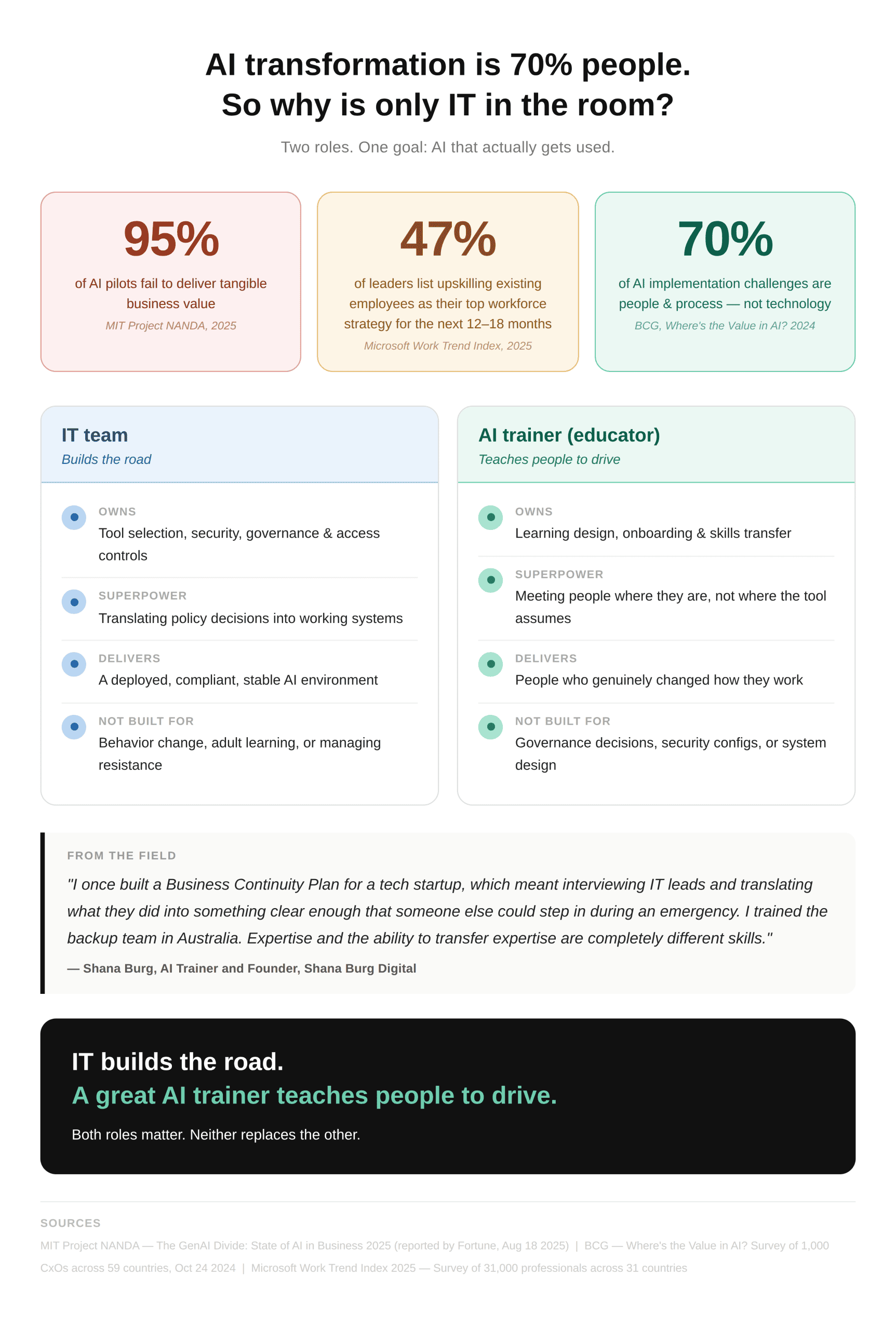
Organizations everywhere are deploying AI tools. According to MIT’s Project NANDA, 95% of enterprise AI pilots fail to deliver tangible business value. That’s not a technology problem. The tools work. The models are capable. The infrastructure gets built.
What doesn’t get built is the bridge between the tool and the person using it.
There’s a gap most organizations don’t talk about: the space between “the tool is deployed” and “people actually use it well.” That gap is a teaching problem, not a technical one. And the critical skill for closing it isn’t technical fluency. It’s good teaching.
What IT does and doesn’t do
IT teams are exceptional at what they do. Their core strengths include:
- Evaluating and selecting the right tools
- Setting governance policies and managing security
- Controlling access and permissions
- Turning policy decisions into working systems
That is the foundation everything else is built on, and it’s not a small thing.
But there’s a reason you wouldn’t ask your network administrator to train your sales team on consultative selling. The skills don’t overlap. Knowing how a system works is not the same as knowing how to help someone change their behavior around it.
BCG’s research backs this up: approximately 70% of AI implementation challenges stem from people and process issues, not technology. Yet in most organizations, when it’s time to roll out a new AI tool, the only people in the room are from IT.
Why teaching credentials matter for AI training
When I built that Business Continuity Plan, I wasn’t valuable because I understood the technology. I was valuable because I could listen to someone who lived inside their expertise and translate it for someone who didn’t. That’s a teaching skill.
An AI trainer with an education background brings a distinct set of capabilities to the table:
- They know how adults learn. Sequencing information, anticipating confusion, and building confidence are core teaching skills that IT training rarely addresses.
- They meet people where they are. Not where the tool assumes they are.
- They design for behavior change. Not just feature awareness.
- They know how to handle resistance. And it’s rarely about the technology.
Employees aren’t resisting AI because they’re incapable. They’re resisting it because no one has made it feel relevant, approachable, or safe. Microsoft’s 2025 Work Trend Index found that 47% of leaders list upskilling existing employees as their top workforce strategy for the next 12 to 18 months. That’s nearly half of all leaders identifying a teaching challenge, and most are handing it to IT.
Both roles. One goal.
This isn’t an argument against IT. It’s an argument for adding the right seat at the table.
IT builds the road. A great AI trainer teaches people to drive. Both matter. Neither replaces the other. The organizations getting the most out of AI aren’t just the ones with the best tools or the tightest governance. They’re the ones where people genuinely changed how they work.
The question isn’t whether your organization needs AI. That decision has already been made. The question is whether you’re investing in the skill that actually determines whether it succeeds.
Key takeaways
- 95% of enterprise AI pilots fail to deliver tangible business value. The bottleneck is rarely the technology. (MIT Project NANDA, 2025)
- Boston Consulting Group found 70% of AI implementation challenges are people and process problems, not technical ones. (Boston Consulting Group, 2022)
- 47% of leaders name upskilling employees as their top workforce priority for the next 12 to 18 months. (Microsoft Work Trend Index, 2025)
- IT’s superpower is translating policy into working systems. That is not the same skill set as driving adoption.
- The gap between “deployed” and “used well” is a teaching problem. Closing it requires someone who knows how to teach.
- Great AI adoption needs both roles: IT to build the infrastructure, and a skilled trainer to change how people work.