My first book took eight years from seed to published story. For the second, I was so proud when I halved my time: four years.
Now with the right combination of editorial expertise, AI tools, and your own original material, it’s possible to create truly outstanding work in a fraction of the time.
But this efficiency comes with complex ethical questions.
The New Creative Dilemma
The Age of AI forces all artists to confront difficult questions about inspiration, reference, and ownership.
Recently, I discovered something jarring: my books have been included in LibGen, a massive dataset of published works being used to train AI models like Meta’s Llama.
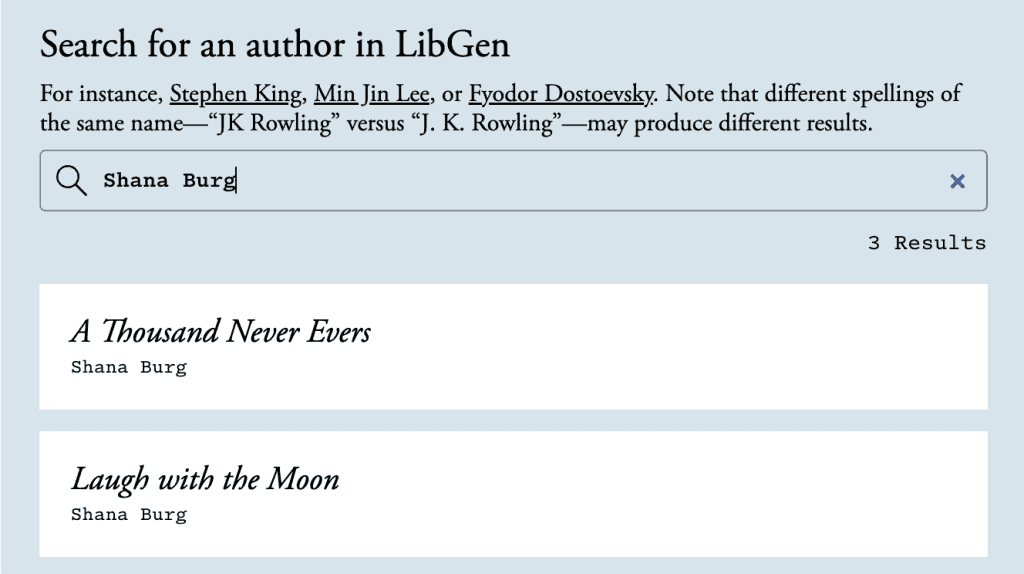
Yes—12 years of my creative life, fed without permission into algorithms owned by tech billionaires.
A year ago, this discovery would have devastated me.
Today, I find myself surprisingly calm. Not because it’s right, but because I’ve spent two years adapting to our new AI reality. The question isn’t whether our work will be used—it’s what we’ll do in response.
What Are the Upsides?
For the artist, the upsides may be hard to spot. What good can come from having your work “appropriated” “scraped” “taken” without your permission?
Well, this: You can fight back.
You can harness the technology yourself to create better, higher-quality versions of art than any non-artist without your eye or expertise ever possibly could.
How so?
Because you’ve been in the trenches.
- You’ve mixed the oil paints.
- You’ve edited that video scene frame-by-frame.
- You’ve revised the same chapter a million times until you bit off all your fingernails and were finally satisfied.
Someone without your depth of experience could never shortcut their way to the same final product with AI.
But Will You Steal Back?
In the Age of AI, the artist would be a fool not to contemplate stealing back as a part of their strategy.
For example, let’s say I’m building a custom chatbot to help me write YouTube video scripts.
And suppose I link a chatbot to a few of my favorite YouTube videos by other creators so that the chatbot can get familiar with the video structure I like. That could be bad.
But then, let’s say, I also feed the chatbot my original blog posts which the video scripts will discuss.
Have I stolen? Is this wrong? Am I being stubborn if I don’t get onboard? If you can’t beat ‘em, should you join ‘em?
From Where I Sit Now
Artists have always gleaned insights and inspiration from the works of other creatives in and out of their genre or medium.
If you want to use chatbots like ChatGPT, Gemini or Claude, you’ll be working on stolen datasets. At this point, it’s completely unavoidable.
I also think that we’ve entered a new era in which everything published will eventually be taken and reshaped into other forms.
So my advice is this:
- Your most important relationship is with yourself. Though you can’t control what others steal and train on, you can remain conscious of what you, yourself, upload. As I explained in my document “10 Rules of The Road for Creatives in the Age of AI,” it might be helpful to write a personal AI policy.
- Be aware of when you’re using source knowledge that doesn’t belong to you. Draw inspiration but don’t copy without attribution.
- If an LLM spits out a revolutionary idea that is not yours, use Perplexity.ai to search for it to make sure the concept doesn’t belong to someone else.
The way I’m fighting back is by living in the world in which I find myself. I’m claiming my power by understanding the technology, and continuing to be the original thinker and creator I know myself to be.
Shana Burg is the author of Poof! The Disappearance of a Writer in the Age of AI, a memoir that explores the transformative impact of artificial intelligence on the everyday lives of writers and other creatives. She is also the award-winning author of Laugh with the Moon and A Thousand Never Evers, books for young readers.