
Are you tempted to generate a book quickly with AI? It’s not a bad idea, but if you don’t go about your AI book writing the right way, you’re likely to end up with a generic manuscript that will hurt rather than enhance your reputation. There are so many great reasons to write a book from scaling your thought leadership to leaving a legacy. But if you’re using AI to help you, you’ll want to avoid these five common mistakes:
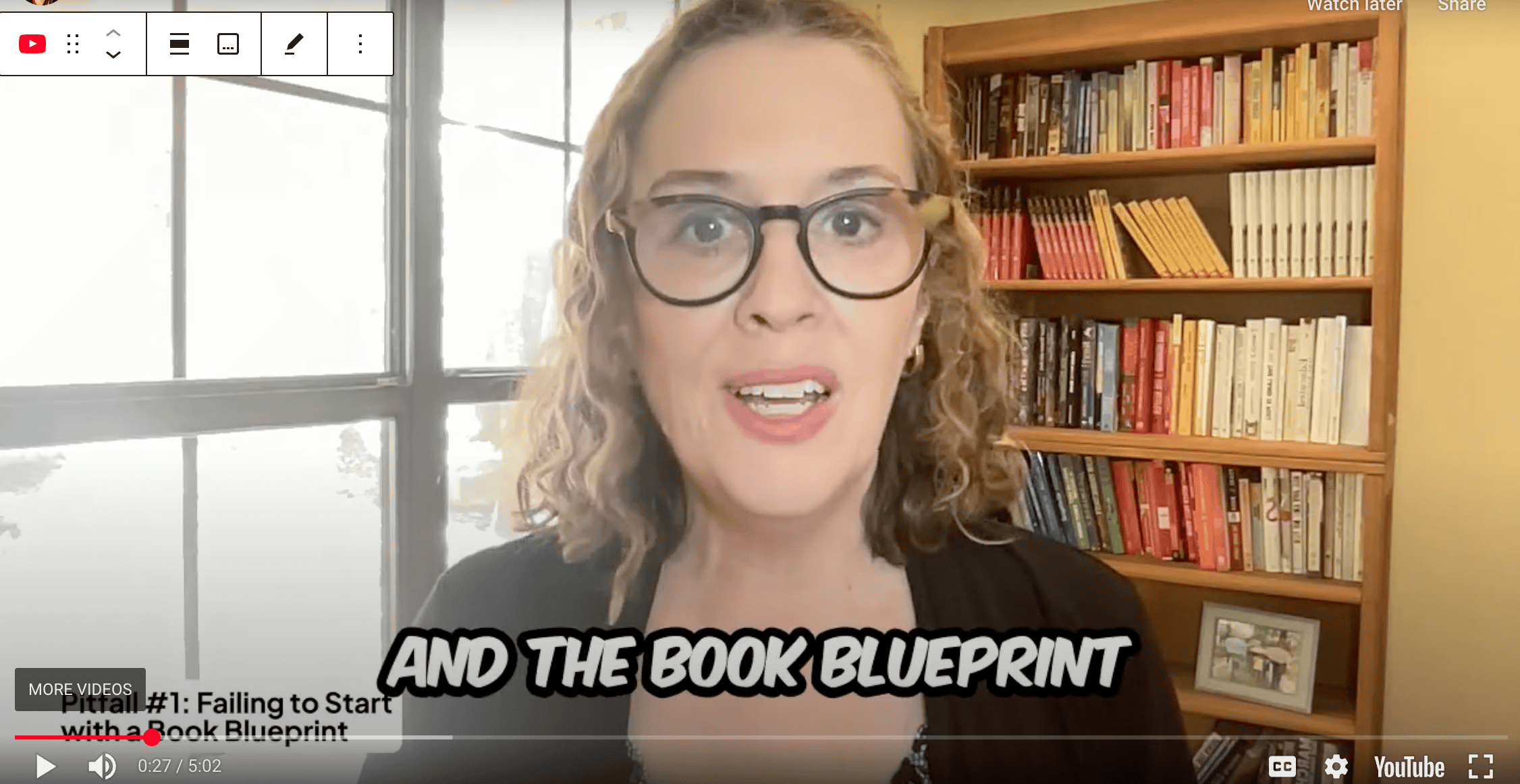
Pitfall #1: Failing to Start with a Book Blueprint
You want to. start with a Book Blueprint that includes your Ideal Reader Personas, a Tone of Voice guide and your written goals for the book. You’ll also want to build a detailed chapter-by-chapter outline. Once you have created these key documents, you can upload them to the knowledge base of your custom AI chatbot and instruct the chatbot to refer to these documents when creating your book chapters.
By doing this foundational work, you are going to help the AI generate content in your voice that will resonate with your target readers and adhere to the message you want to convey. After you generate a chapter, ask the AI to rate your chapter 1-10 on how well it adhere to each of these key documents in your Book Blueprint.
Pitfall #2: Letting AI Speak for You
Use AI as a collaborator and not a ghostwriter. In other words, though tempting, do not let AI lead you. Sometimes it feels that the AI is so smart you should just listen to its ideas wholesale, without really stopping to think them through. This is a mistake. AI often makes things up (aka hallucinates) and often what it says sounds authoritative on first glance, but on second thought, makes no sense at all.
The way to prevent this is to feed your custom AI chatbot lots of material that you’ve previously created, such as articles, transcripts of speeches, or other books you’ve written. However, if you don’t have any such previously created material, you’ll just need to work extra hard to make sure the ideas you’re generating are ones that truly align with your beliefs and your original ideas.
Pitfall #3: Using the Wrong LLM for the Job
An LLM is a Large Language Model. It is the gigantic dataset that a chatbot like ChatGPT, Claude or Gemini rests on top of and pulls information from. Not all LLMs and chatbots are built for the same purpose. If you’re writing a full-length book, you might want to use a heftier version such as ChatGPT 4 Turbo or Claude Opus. On the other hand, you’ll want to use lighter models for brainstorming or quick summaries. Match the LLM to the job.
When building a custom chatbot (get my free step-by-step guide here), you’re going to need a paid version which is about $20/month for each. But if you want access to several LLMs for the same $20/month, an LLM aggregator can be an excellent solution.
Pitfall #4: Not Helping AI Digest Information
Let’s say you upload 50 articles you’ve written previously to your custom chatbot. Now you think, “Awesome! It knows everything I know.” Well, not so fast. Your AI chatbot is likely going to have trouble really understanding so much information. The solution is to use something called chain-of-thought prompting. Here’s what to do:
- Upload one article at a time to the knowledge base.
- After each upload, ask your chatbot to summarize the document in 100 words.
- Repeat this for every article you add to the knowledge base.
- Once you’ve uploaded all documents to the knowledge base, ask the AI to create a glossary of articles in the knowledge base for you. Prompt it to include the title of each article with a one-sentence summary. Then download your Glossary and upload it to the knowledge base.
- Next time you prompt your chatbot, tell the AI to refer to the Glossary in order to find the correct information for a particular book chapter.
This chain-of-thought prompting helps AI digest the information you’ve uploaded to the knowledge base so that it can make use of it in service of helping you write a book with your ideas in your own voice.
Pitfall #5: Never Using a Human Expert to Review the Manuscript
You might be an expert therapist, CEO, or technologist. As a subject matter expert, you know things the AI won’t know. You will need to review all content to make sure it’s accurate. In addition, you’ll want an expert book editor to help ensure you’re telling your story in a way that will best resonate with your target readers and meet your overall goals for the book.
If you want help writing a book in 60 days, apply to work with our team of professional writers, editors and AI specialists here: