Not all AI writing is created equal.
“So you just press the button? You must be done in a day!” my friend said the other day.
No, not really. In fact, not even close. “I just spent a 150 hours on a recent project,” I said.
She looked puzzled. “But I thought you’re using AI?”
“I am!” I said, a bit too exasperated.
After the millionth time trying to explain how writers can use AI in their process, I realized I needed a better way.
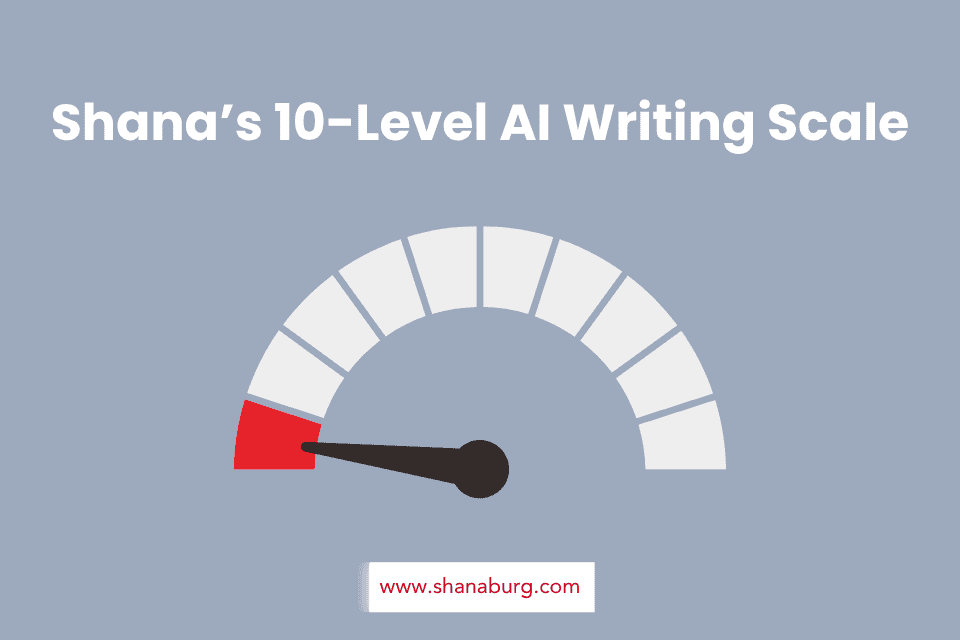
So I created a 10-level spectrum to help explain how AI can fit into the writing process—from push-button content to 100% human-crafted prose
I work at Level 7. This means AI helps me embed a client’s voice and message into text. But here’s what’s critical to note:
–>AI assists—but never replaces.
–>Every fact is checked by a human. (This is crucial!)
–>Every sentence is human-edited.
Where do you fit on my AI writing scale?
Take a look at the scale and let me know:
👉 If you’re a writer, what level do you work at?
👉 If you hire writers, what level do you expect?
In a time when the very definition of “writer” is changing faster than you can create a prompt, this scale has helped me explain how it all really works.
Level 1: Push-Button AI
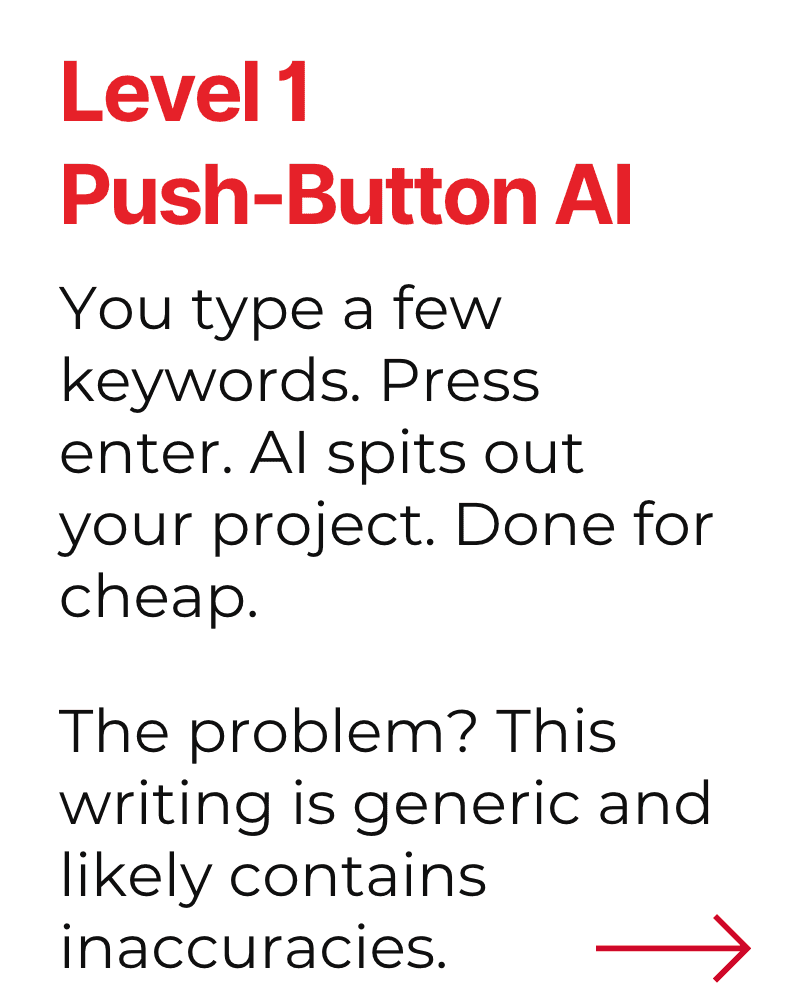
If you’re at Level 1, you type a few keywords into an AI chatbot, something like “Write me a press release about our new dog shampoo.” AI spits out your press release. The work is done for you and it’s cheap—maybe even free, depending on if you are using a paid or free plan for your chatbot.
The problem with Level 1 writing is that it’s generic and most likely contains inaccuracies that reflect poorly on you or your brand.
Level 3: Prompt-Based AI
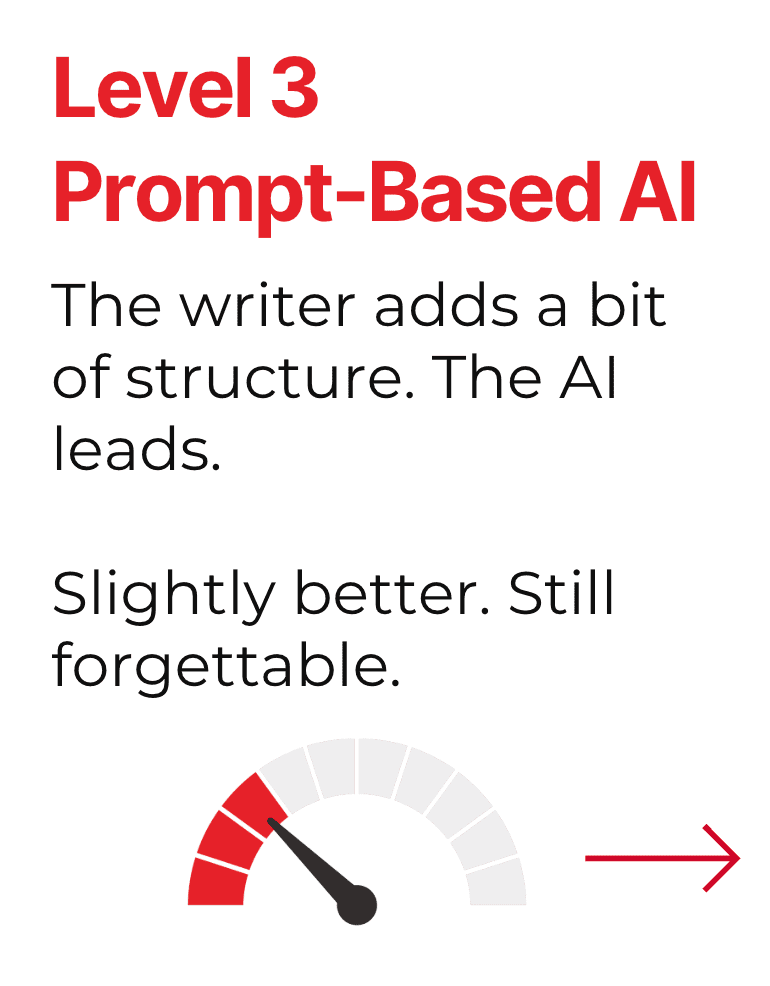
If you are working here, you are giving the AI chatbot more detailed prompts. You may be adhering to my 4Rs of prompting, by specifying the AI Role, laying out the Rules, explaining your Reason for the task, and clarifying the desired Result.
The prompt adds much-needed structure and the output will be greatly improved from Level 1 AI writing, so we’re getting better quality but still, don’t go passing this off as professional work. There’s a lot of room to improve as far as making the work unique and resonant.
Level 5: Idea-Led Writing
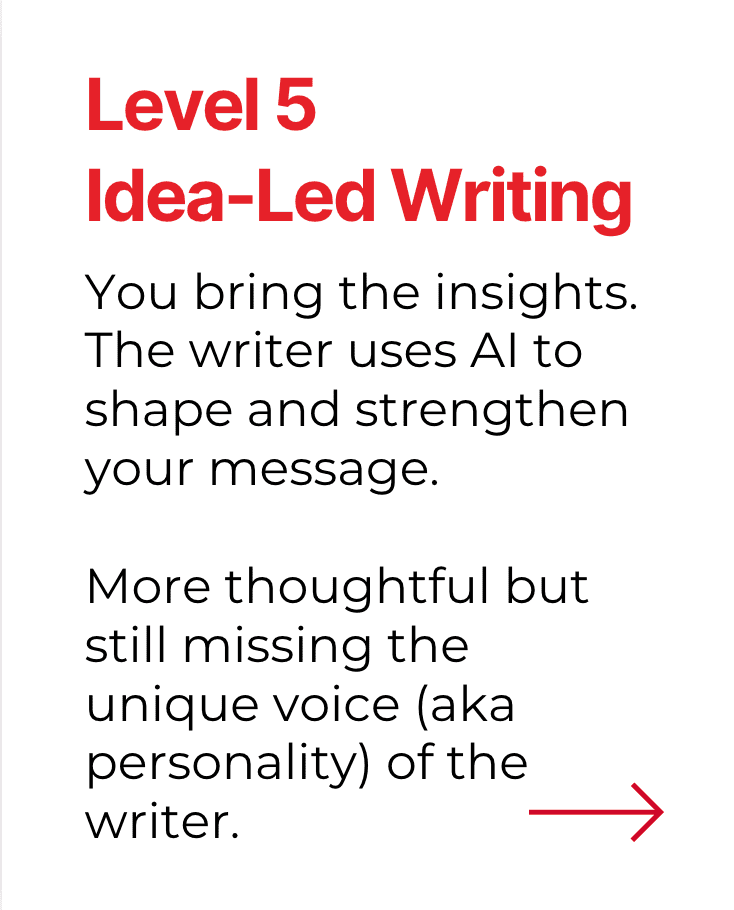
At this level, you are providing significant human insights. The ideas are coming from you first, and not the chatbot: You are in the lead. The output is more thoughtful, however, it still reads as generic because it lacks your unique personality. You can still do better without too much additional effort.
Level 7: Voice-Trained Writing
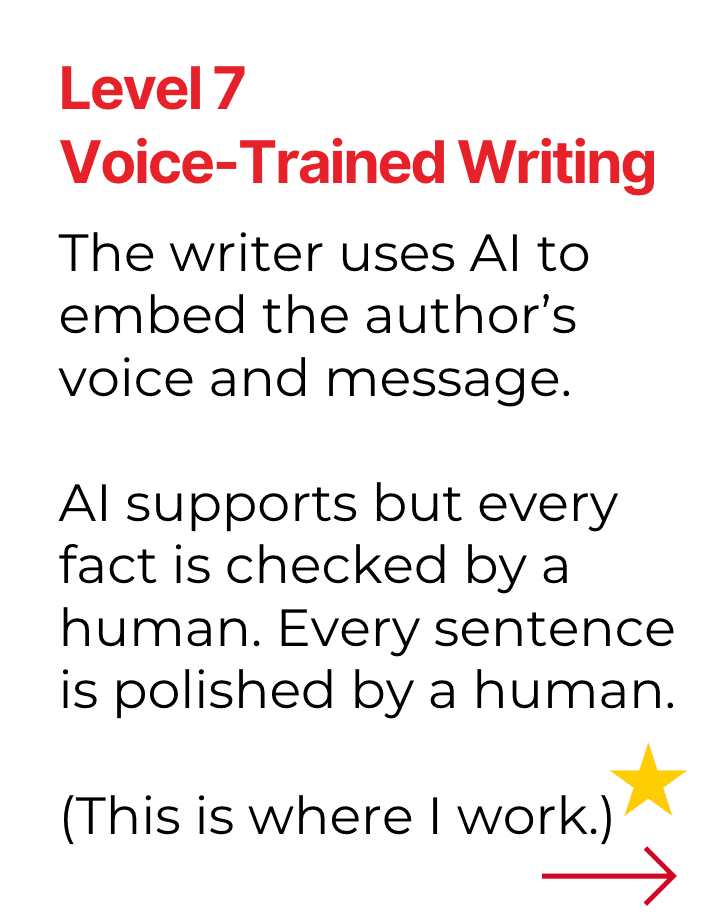
At this level, the writer uses AI to embed the author’s voice and original message. (The “author.” may be the writer, but if you’re ghostwriting, the author is your client.) All the content sounds like it could have only been written by one particular person because it’s that unique.
At Level 7, every fact is checked by a human and every sentence is polished by a human, too.
For me, Level 7 is the sweet spot, where I can take advantage of AI to accelerate the process and improve quality without losing the originality that makes a true work of art—in this case the writing—sparkle. ✨
Level 10: 100% Human Writing
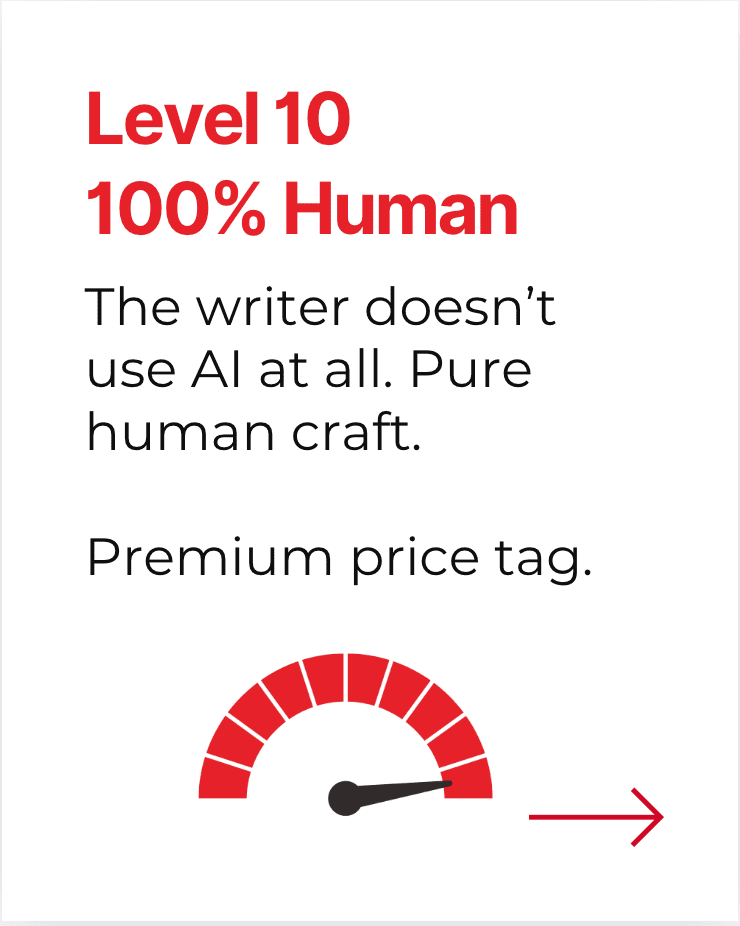
This is what we all did until at least November, 2022 when ChatGPT was released to the masses. Many writers still work at Level 10, where the writer doesn’t use AI at all and the product is the result of pure human craft.
The problem with Level 10 writing is just that it takes so much longer than Level 7 writing, and you don’t benefit from the insights AI chatbots can contribute to make you strengthen your work even more. Because of the time sink, hiring a Level 10 writer usually comes with a premium price tag.
The AI Writing Scale and Price
If you are a writer, the further up the scale you work, the more you can charge. If you are hiring a writer, you can expect to pay more for writers working at Levels 7-10. However, the more you invest, the higher the potential ROI, so that’s something to consider.